The cooking principle overlaps
USDA describes an air fryer as a countertop convection oven. Both use a fan to move heated air. That similarity explains why both can brown and crisp exposed surfaces, but it does not mean every recipe will take the same time or taste identical in both machines.
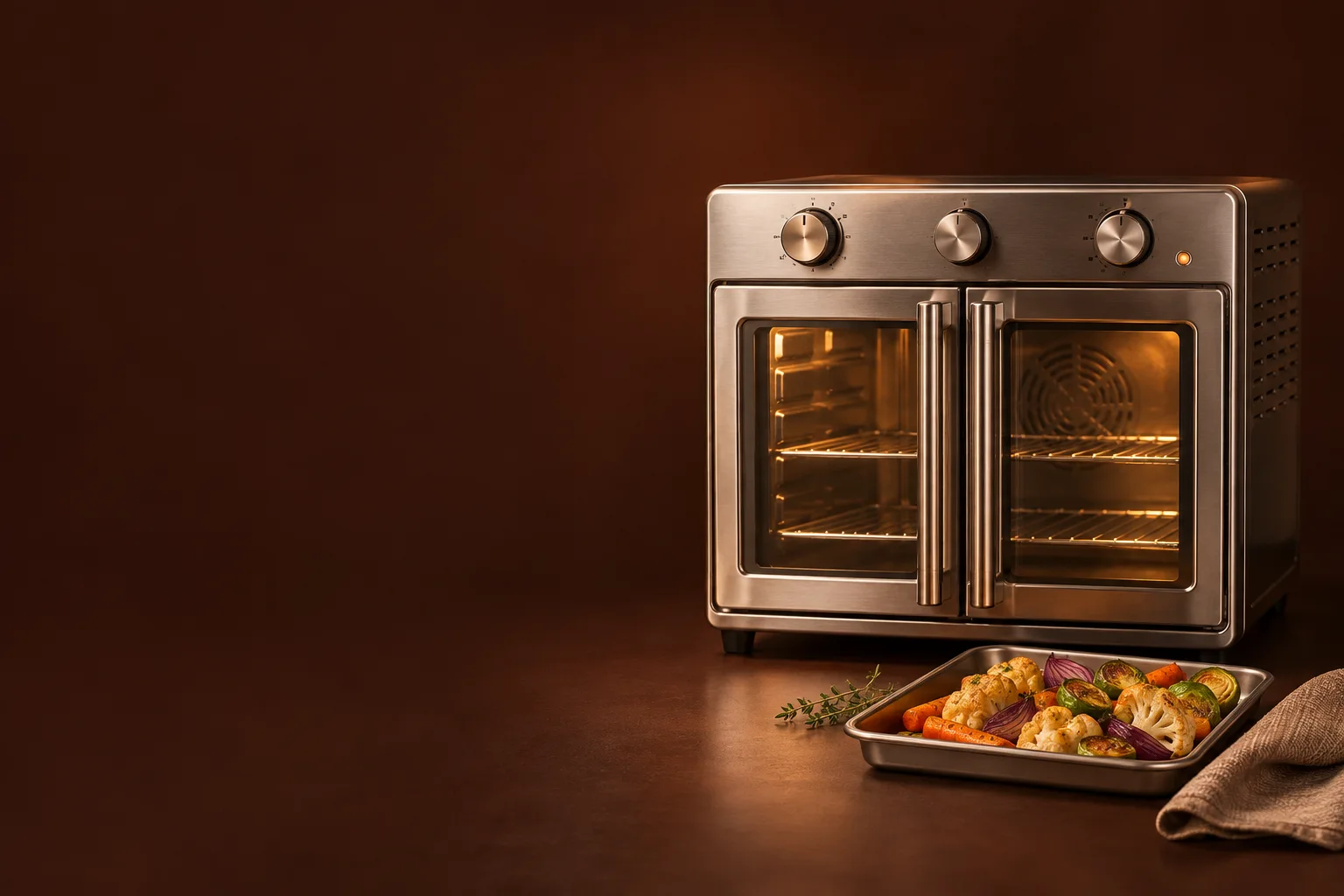
Basket air fryers typically put food in a removable drawer near a heater and fan. Countertop convection ovens usually have a door, shelves and room for a tray or shallow dish. Full-size convection ovens add still more space. Whirlpool's comparison notes that heating element placement, capacity and preheating can differ. Some ovens also provide an air fry mode, so the categories overlap at the edges.
For a closer look at the heater, fan and perforated basket, see our how air fryers work explainer. Here, the practical question is what those parts let you cook in one session.
Compare floor area, not just capacity labels
A basket's quart figure and an oven's cubic-foot figure measure different volumes. Neither tells you how many wings, vegetables or slices of bread can be spread out. Crisp cooking depends on exposed surface, so usable floor area is often the more helpful measure. A deep basket filled to its maximum line can still produce uneven results if pieces are piled together.
Measure the tray or basket interior and compare it with a normal meal. If you roast vegetables for four, work out whether they fit in one loose layer or need two rounds. If you bake cookies, check the width of the tray and the rack clearances. A larger oven may take more counter space but prevent the second batch that erases a small cooker's time advantage.
Do not assume multiple oven shelves automatically double crisping capacity. Shelves may need rotation, and the manufacturer may limit rack positions for a particular mode. Breville's rack-position guidance says the recommended position depends on the function and model. Read those instructions for the machine you own or intend to buy.
A basket is easy to shake; an oven accepts wider food
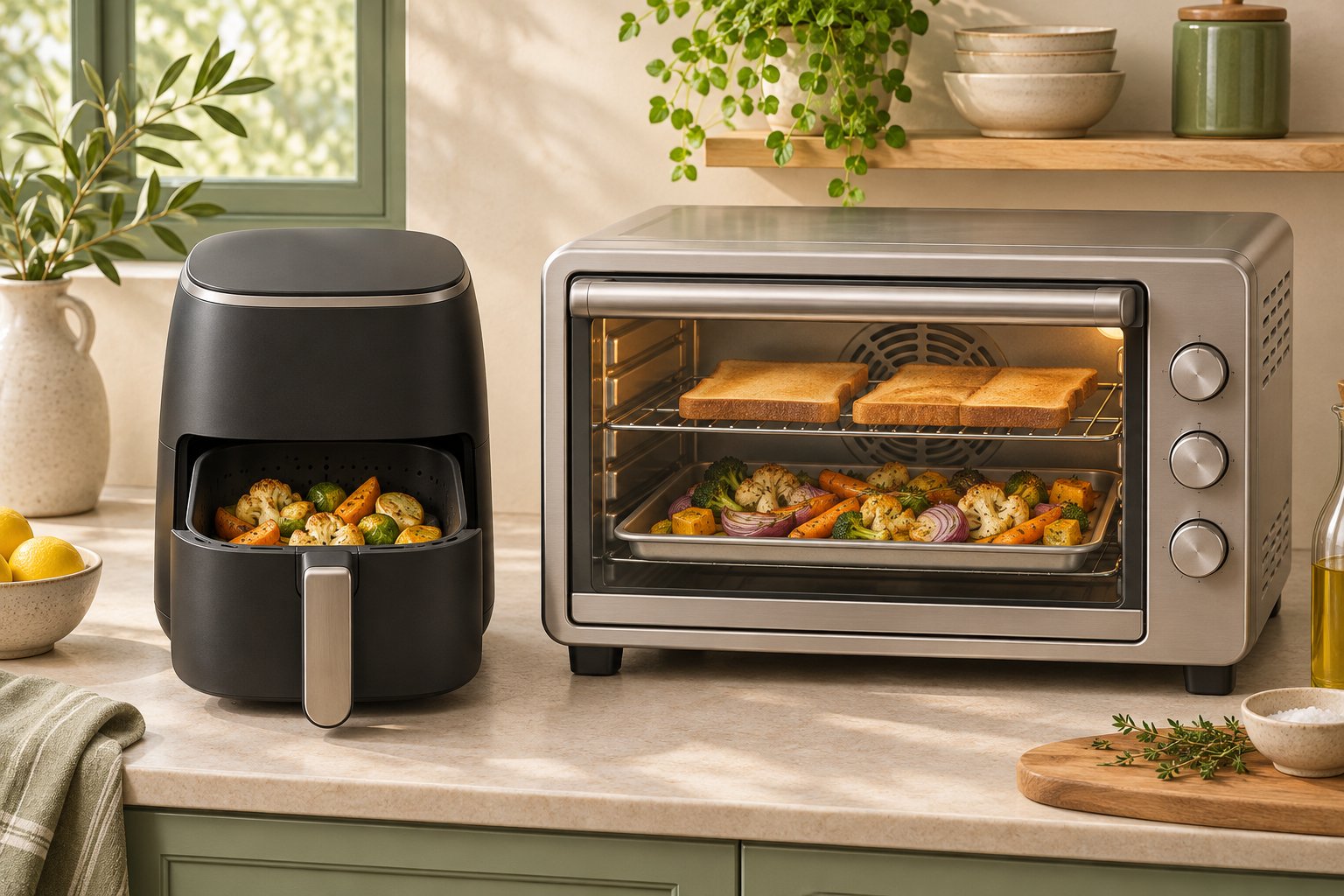
The drawer is useful for foods that benefit from a mid-cook toss. Pull it out, shake the contents as instructed, and return it. A shallow oven tray may be better for pizza slices, toast, a baking dish or a wider group of vegetables. It can be easier to see the food through a door without interrupting the cook, although the glass and racks add cleaning surfaces.
Consider the tools you already use. A basket can be awkward for a delicate fish fillet or anything that must stay flat; an oven tray may lift it out more easily. A small batch of fries may be easier to shake in a drawer than to turn one by one on a tray. These are workflow differences, not evidence that one type always cooks better.
Some countertop ovens have an air fry basket or perforated tray. Whirlpool's guide to oven air frying recommends a perforated basket or low-sided tray to expose more surface to moving air. Use only cookware allowed by your model, with the rack position and drip-catching arrangement its manual specifies.
Speed depends on the meal, not the appliance name
Small air fryers often preheat quickly because their cooking chamber is compact. For one portion, that can make dinner feel faster than heating a large oven. But a family-sized meal may require successive basket loads. Total time then includes each batch, any preheating and the effort of keeping earlier food warm safely.
Compare a complete task. If an oven roasts a full tray in one run while a basket needs three, the oven may finish the meal sooner even if each basket run is short. If you only cook a single side dish, the basket might be more convenient. Neither conclusion follows from a preset's displayed time alone.
A recipe written for a conventional oven is not a guaranteed air fryer schedule. Food thickness, starting temperature, basket crowding and the appliance's airflow can alter the result. For meat and poultry, use the FoodSafety.gov temperature chart and a thermometer rather than relying on a crust or timer. Our repeatable air fryer tips explain how to record useful adjustments.
Electricity claims need a defined comparison
It is tempting to say that the smaller appliance always costs less to run. The actual energy used depends on the appliance, its power draw over time, food quantity, preheating and whether you need several batches. A wattage label is a rated power figure, not the energy consumed by a particular dinner.
To compare your own machines, use measured energy for the same portion and acceptable result, including every batch. Avoid comparing a single air fryer run with a full oven run that feeds more people. If the test recipe or serving count changes, the result no longer answers the same question. The US Department of Energy's oven analysis illustrates how controlled testing treats cooking efficiency as a measured quantity rather than a claim inferred from a fan or a wattage sticker.
Space and convenience may matter more to you than a small energy difference. If a second appliance needs scarce counter and storage space, include that cost in your decision.
Think about cleanup and counter clearance
A basket and removable drawer can be carried to the sink, but grease can also collect around the insert and above it near the heater. An oven may have a crumb tray, wire racks, baking trays and interior walls. Check which parts are dishwasher-safe and how the coating or glass must be cleaned. Our air fryer cleaning guide covers one side of that comparison.
Measure your counter before ordering. A drawer needs room to pull forward; a door needs space to swing open, and a hot tray needs a safe landing place. Both types need the ventilation clearance in their own manuals. Avoid assuming that a compact body can be pushed against a wall or operated under low cabinets.
Look at the controls too. A basket may be easy to operate with one dial; an oven may offer separate bake, toast, broil and air fry functions. Extra modes are useful only when they match the tasks you do. If your current convection oven already handles those tasks, try a recipe with suitable cookware before buying another machine.
A practical way to choose
Write down three regular meals, not an imagined perfect menu. For each, note the portion, the pan or basket area needed, whether you must shake or turn food and whether a second dish needs the appliance at the same time. Then compare the usable interior and the countertop footprint of actual models.
- Choose a basket air fryer when your common portions fit in a loose layer and you value a removable drawer for tossing small batches.
- Choose a convection oven when you regularly need a wider tray, toast or bakeware, or want to finish larger portions in one run.
- Consider an oven with an air fry mode when you need both formats' tasks but have room for only one countertop appliance. Verify the included basket and rack guidance.
For product-level choices, compare our basket air fryers, countertop convection ovens and air fryer toaster ovens. Check the current model dimensions, accessories and seller terms before ordering.
Questions readers often ask
Is a convection oven the same as an air fryer?
They share fan-assisted hot-air cooking, but the chamber size, heating layout and accessories can differ. An oven's dedicated air fry mode may use a perforated basket and a different setting from ordinary convection bake. Follow the instructions for your model.
Can I put an air fryer basket in my oven?
Only if that basket is approved for your oven and fits safely with the required clearances and drip-catching setup. Do not transfer a plastic-handled countertop drawer into an oven. Check the oven and accessory manuals.
Which is better for a family?
Count the portions you can cook at once, then the number of batches for a normal dinner. A larger oven may save repeated runs; a dual-basket air fryer may suit two smaller foods with different settings. Usable area matters more than the headline capacity.
Which makes crispier food?
Either can crisp exposed food with the right cookware, load and recipe. A crowded basket or a deep-sided oven dish can block airflow. Compare the result for the same food rather than assuming the appliance label predicts it.