
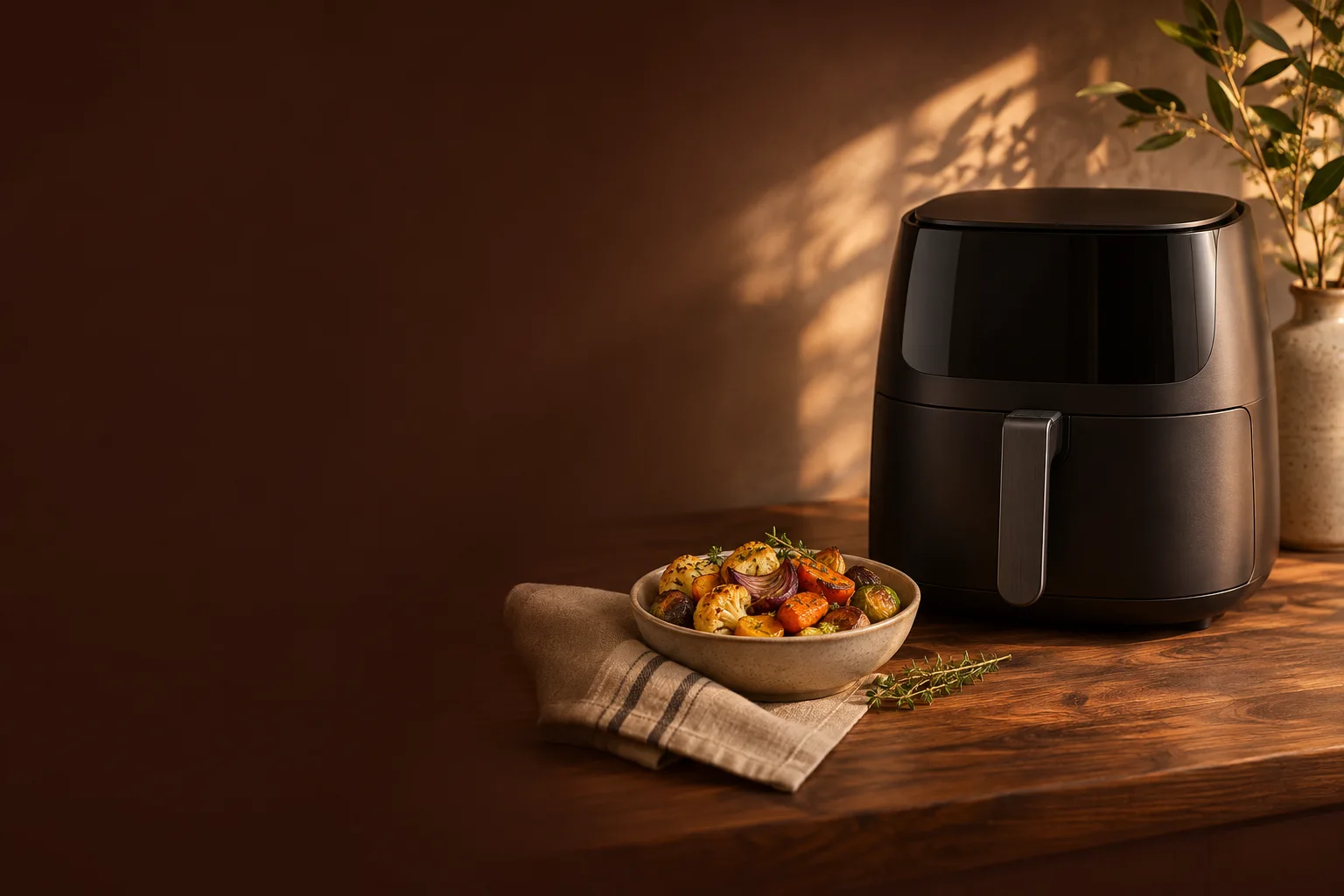
The heater, fan and basket each have a job
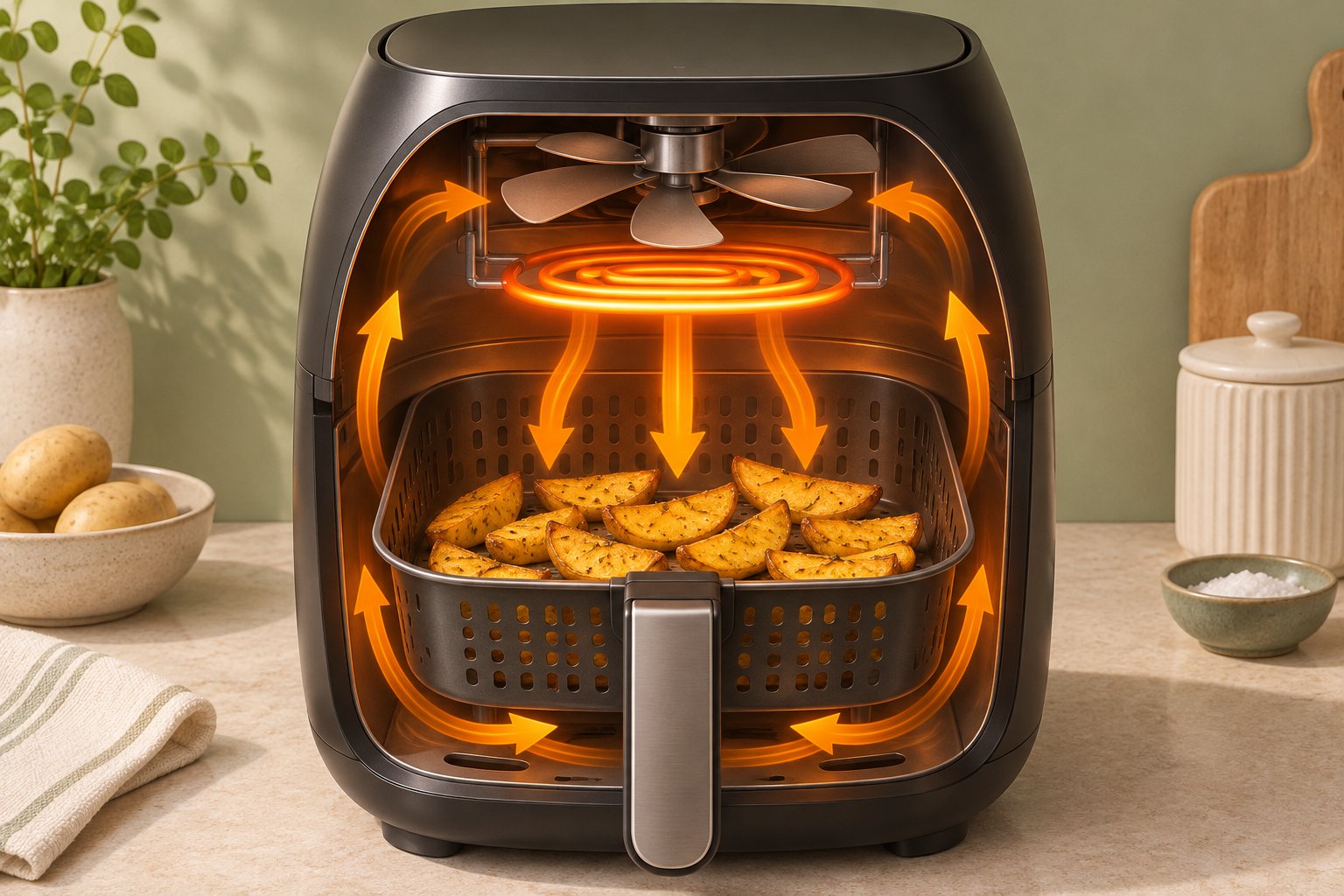
Philips' air fryer manual describes a top grill, high-speed air circulation and a basket that keeps food away from the heating element. The exact location of the heater and fan varies by model, but the principle is straightforward: electrical energy warms the air and the fan carries that heat past exposed food surfaces. The basket lets some air reach the sides and underside as well as the top.
USDA describes air fryers as countertop convection ovens. This is convection cooking on a small scale. Whirlpool's oven comparison notes that both air fryers and convection ovens use fans, though their capacities, heating arrangements and cooking results can differ. An air fryer does not submerge food in oil. It may need a small amount of oil for a particular recipe, but hot air does the main work of carrying heat.
A compact chamber can warm quickly because there is less space to heat. That does not promise the same time for every model or food. The air still has to reach the portion you put inside. Appliance geometry and how the load is arranged matter as much as the preset printed on the control panel.
Why the outside browns and the inside cooks
Heat reaches the outer surface first. Surface moisture evaporates, then exposed starches and proteins can brown while heat continues toward the center. The resulting crispness depends on the food, its moisture, its coating and how long it stays in the cooker. Airflow helps move moist air away from the surface, but it cannot make a wet batter behave like a recipe immersed in hot oil.
A thin, dry potato wedge and a thick, damp piece of chicken present different problems. The wedge has more exposed surface relative to its center. The chicken needs enough time for the middle to reach a safe temperature, even if the outside looks done. This is why a cooking guide is a starting point, not a promise that every piece will finish together.
Do not infer food safety from a browned crust. FoodSafety.gov's safe temperature chart calls for checking meat and poultry with a food thermometer. For example, all poultry needs 165°F at the thickest part. Insert the probe according to its instructions and check more than one piece if their sizes differ.
The basket's floor area matters more than its volume
Manufacturers often advertise capacity in quarts or liters. That tells you how much the drawer holds, not how much food can sit in a loose cooking layer. A tall pile of fries may fit below a fill line while leaving the pieces in the middle shielded from moving air. The result can be a crisp top and a soft bottom.
For a new dish, arrange a modest batch with visible space between pieces. Shake or turn it when the recipe or manual calls for it. If it finishes evenly, note the amount for next time. To feed more people, repeat the batch rather than simply adding a large heap. Our air fryer mistakes guide explains why extra time cannot rescue surfaces that never see enough airflow.
Basket shape also changes what fits. A wider shallow drawer may accommodate more separated food than a narrow deep one with the same stated volume. If you are shopping, compare usable basket dimensions and the portion you actually cook. Our air fryer comparison is a better starting point than treating the largest capacity number as the best fit.
Why shaking and turning change the result
Most basket cookers do not direct the same amount of moving air at every face of every piece. Food resting against the basket or another piece has less exposed surface. A mid-cook shake changes which sides face the air and separates pieces that settled together. Larger pieces may need turning with tongs because a quick shake will not reposition them reliably.
Open the drawer only as often as needed. Each opening interrupts the cooking environment, and the drawer and basket can be hot. If your appliance pauses automatically when opened, confirm that cooking resumes after closing. If it does not, follow the manual's procedure. Keep hands clear of rising steam, use heat-safe tools and set the drawer on a surface that can take the heat.
Some ovens have shelves or perforated trays instead of a pull-out basket. In those machines, rotation or switching rack positions may be the relevant step. The model manual takes priority over generic advice. The goal is the same: expose the parts that were previously hidden and check the food before it dries out.
Presets are starting settings, not sensors of doneness
A fries, chicken or vegetable button usually selects a programmed temperature and time. Some models also change fan behavior. The button does not know whether your food is frozen, unusually thick, lightly coated or packed tightly. Read the manual for what each preset does and use a recipe intended for your style of cooker when possible.
Start checking before the suggested time ends on the first run. If the food is pale, give it more time in short increments. If the outside darkens before the middle is ready, consider smaller pieces, a lower temperature or a smaller load next time. Write down what you changed. A simple record of weight, size, setting and outcome is more useful than repeatedly pressing the same preset and hoping for a different result.
Wattage describes electrical power, not the guaranteed cooking speed of a meal. A higher-rated heater can still perform poorly with an overloaded basket or awkward airflow. Equally, a small air fryer can be quick for a single portion but slow for dinner if it needs several sequential batches. See our air fryer versus convection oven guide when deciding which format fits a full meal.
Oil, liners and ventilation change the setup
A light coating of oil can help some vegetables or breaded foods brown, but the recipe and appliance instructions should determine whether to add any. Never fill the drawer with oil as though it were a deep fryer. The Philips manual expressly warns against filling its pan with oil and against blocking its inlet or outlet. Other brands may set different accessory rules, so check yours.
A solid sheet of paper or foil can cover the perforations the cooker needs. A loose liner may also shift toward the heater when the basket is empty or lightly loaded. Use only accessories permitted by your specific model, and follow their instructions for placement and weight. Keep the appliance's outside vents clear and allow the clearance required by its manual. Do not put it under a cabinet if that violates the manufacturer's spacing instructions.
After cooking, let the machine cool as directed and clear crumbs or grease before they build up. Our air fryer cleaning guide covers baskets, heating areas and coatings without treating the electrical base as a washable part.
What an air fryer can and cannot replace
An air fryer is well suited to portions that can be spread out and benefit from moving hot air. It may be convenient for reheating crisp foods, roasting small batches of vegetables and cooking frozen items according to their package directions. It is less natural for a large casserole, a tall loaf or a meal that exceeds the usable tray area. Some oven-style air fryers accept those dishes, but they should be judged by their own rack dimensions and permitted cookware.
Compared with deep frying, the texture and preparation are different. A wet batter designed for immersion frying can drip through a basket, and hot air will not surround it with liquid oil. Our air fryer versus deep fryer guide explains that trade-off. Compared with a conventional oven, the useful question is whether your ordinary portion benefits from a smaller, easier-to-access cooker enough to justify another appliance.
Likewise, no appliance makes a food nutritious by itself. The ingredients, added oil, coating, serving size and the rest of the meal still count. Treat sweeping percentage claims as claims about a defined comparison, not as a prediction for every recipe in your kitchen.
Common questions about air frying
Does an air fryer cook food from the inside out?
No. Heat reaches the surface first and moves inward. That is why thick pieces can look browned before the center is done. Use a thermometer where a safe internal temperature matters.
Do I have to preheat it?
Follow the recipe and your model's manual. Some dishes and models benefit from preheating; others account for a cold start. Changing that step changes the effective cooking time, so keep it consistent when comparing batches.
Can I stack food above the basket floor?
Only within your model's loading limits and with the expectation that a stacked load may need turning or separate batches. For crisp foods, a loose layer usually exposes more surface to the circulating air.
Is every air fryer also a convection oven?
It uses convection, but appliance labels cover different sizes and heating layouts. A basket model, a countertop oven with an air fry mode and a full-size convection oven can yield different results for the same recipe.